My stepmother chased me onto a rain-soaked highway with a leather belt in her hand, then told the police I was mentally ill when I escaped into a stranger’s car.
I was bleeding from my forehead, my ribs felt cracked, and my old phone was hanging together with a strip of tape. Estela Cruz stood in the middle of the road, screaming that I had stolen from her.
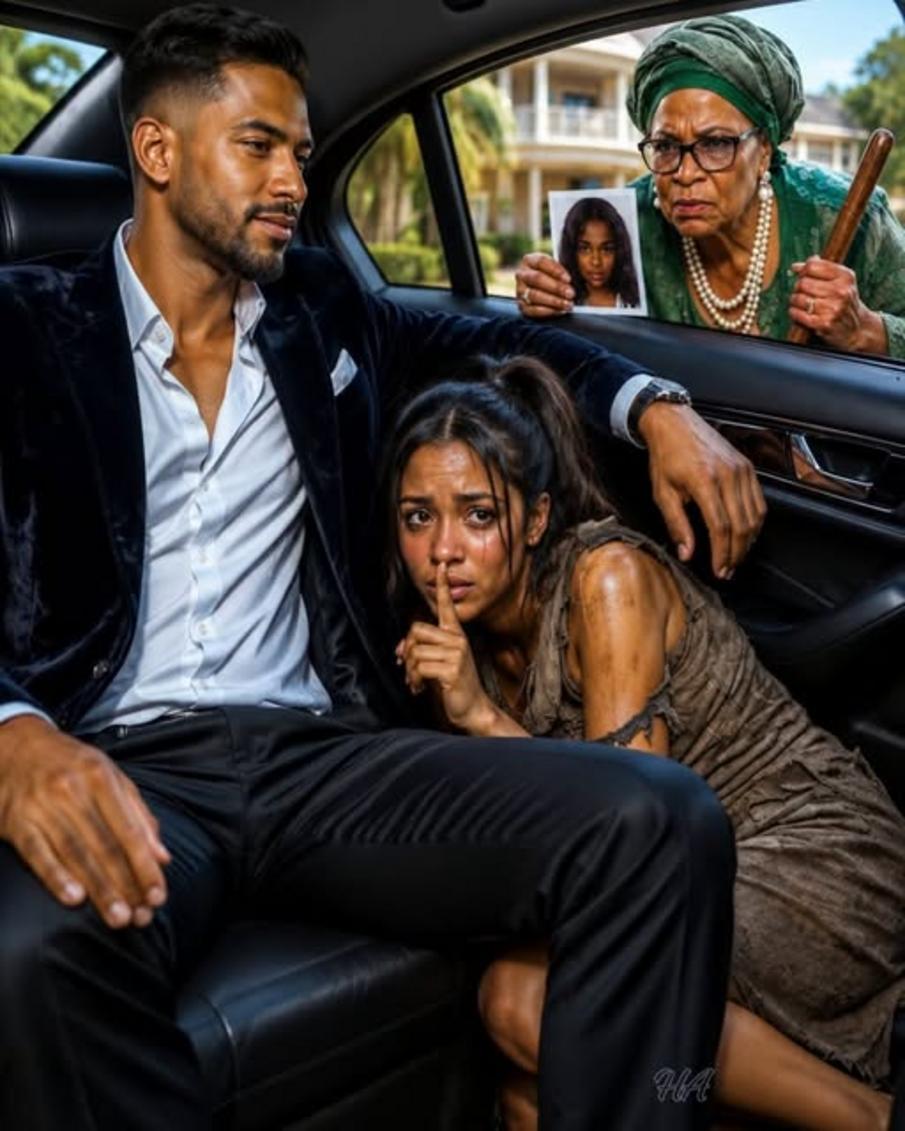
“She belongs to me!” she shouted when the driver lowered his window. “She is unstable. Take her home!”
The driver was Ignacio Alcázar, a wealthy businessman whose name I recognized from newspapers. He looked at the bruises on my arms, then at Estela’s belt.
“Get in,” he said.
“She’ll follow us.”
“I know.”
His car tore through the rain toward his estate while Estela’s headlights stayed behind us. Every few seconds, my phone vibrated with another message from her.
Come back now.
You know what happens when you make me angry.
At the estate, Ignacio’s security team locked the gates. A housekeeper brought me dry clothes, but I kept staring at the blue thread hanging from the sleeve of my torn jacket. Estela had ripped the button off when I tried to pull away.
Ignacio did not touch me.
“You can call anyone you trust,” he said. “You can leave whenever you want.”
I almost laughed. Nobody had said that to me in years.
Then an elderly woman entered the room carrying a gray sealed envelope and a faded photograph. Her hands trembled so badly that the picture rattled against the frame.
“My name is Mercedes Rojas,” she whispered. “I knew your mother.”
I froze.
“My mother died before I was born.”
“That is what they told you.”
Ignacio’s face changed. He had gone pale before Mercedes even turned the photograph around.
It showed a young woman holding a newborn. The baby had a crescent-shaped birthmark on her wrist.
I looked down at my own wrist.
The same mark.
“No,” I said. “My father was Mateo Cruz. He raised me. He loved me.”
“Both things can be true,” Mercedes replied through her tears.
Then she placed a small brass key on the table.
Before anyone could ask what it opened, headlights swept across the tall windows. A security guard rushed in and announced that police officers were at the gate with Estela and an emergency guardianship petition.
Estela’s voice rang through the house.
“Bring me my daughter!”
Ignacio’s attorney opened the document, and her fingers stopped on the final page. Mercedes reached slowly toward the gray envelope…
PART 2
Mercedes reached slowly toward the gray envelope, but the front doors burst open before she could touch it.
Estela entered behind two officers wearing a frightened expression I had seen her practice in the mirror. Her hair was damp, her hands were folded over her chest, and her voice sounded soft enough to fool anyone who had never lived with her.
“There you are, sweetheart,” she said. “You had another episode. Come home.”
I stayed beside the table.
“Show them the guardianship order.”
Estela smiled. “You see? She is confused.”
Ignacio’s attorney read the papers, then looked up. “This petition was filed, but it was never granted. There is no judge’s signature and no court seal.”
For the first time, Estela glanced toward the door.
I lifted my cracked phone. “My father recorded messages before he died. I also recorded tonight.”
I pressed play.
Estela’s voice filled the hall: “Come back now, or I will make sure they lock you somewhere nobody will hear you.”
Then came the sharp crack of her belt against a wooden door, followed by my scream.
The officers’ faces hardened. Estela shouted that the recording had been edited, but Ignacio’s security chief placed a dashboard video on the table. It showed her striking his car and chasing me through the storm.
She was detained for questioning.
I thought the nightmare had finally cracked open. I was wrong.
The next morning, Mercedes took us to an abandoned private clinic outside Toluca. She had hidden one box of records in a church storage room after learning that the clinic files were being destroyed.
Inside was a photograph of my mother holding me as a newborn, intake papers, and a letter addressed to Ignacio. He opened it with shaking hands.
Iggy, if you are reading this, I failed to get far enough away. Mateo helped me hide my daughter. Do not blame him. Arturo has friends in the police, and Estela is telling everyone I am delusional. They want the trust Grandmother left me. Please believe Valeria, and let her choose.
Ignacio walked outside and broke down beside the rusted fence. I had spent my life believing tears were weakness, but I brought him a chair.
Four days later, DNA confirmed he was my uncle.
The brass key opened a safe-deposit box rented by Mateo. Inside were photographs of my mother’s injuries, letters about a plan to have her declared incompetent, and a notebook warning that Estela knew I would soon control the trust.
There was also evidence that Mateo had not died of a heart attack. And the payments led to a man believed dead for fifteen years: Arturo Varela, my mother’s uncle.
That night, my phone rang. The caller identification displayed Mateo’s name.
A man whispered, “You have Amelia’s eyes.”
Then he demanded the original cassette and threatened Mercedes. When I looked toward the guesthouse, her room was empty. On her pillow lay one black stone from a silver compass pendant.
At midnight, I walked into the abandoned San Gabriel station carrying a copy of the cassette. Mercedes sat tied beneath a work light. Behind her stood a gray-haired man wearing the matching compass.
He smiled and raised a knife toward my throat…
PART 3
He smiled and raised a knife toward my throat.
“Your mother walked in exactly like this,” Arturo Varela said. “Terrified, pretending not to be.”
I placed the brass key and the cassette on a broken bench. “Let Mercedes go.”
Arturo laughed. He spoke calmly, as if he were explaining a business deal. He said Amelia had been emotional and difficult, that nobody believed her accusations, and that Estela had only been useful. Then he leaned closer.
“She refused to sign over the trust,” he whispered. “So I corrected the problem.”
My hidden microphone was transmitting every word to the police waiting in the underground passage.
“Did you kill Mateo?” I asked.
“He should have handed over the key.”
“And my mother?”
His smile finally disappeared. “She ran after giving birth. Mateo found her near the ravine. I found them first. I pushed the car. She was already bleeding.”
Behind him, Mercedes worked one hand free. I kept Arturo talking until he noticed the faint static from my microphone. He tore it from my dress and dragged me toward the tracks.
That was when Mercedes swung the broken chair into his knee.
I drove my heel onto his foot and pulled her behind a concrete pillar. Police flooded the platform. Arturo ran for the far exit, but Ignacio stepped from the shadows and charged after him.
Arturo raised the knife.
“Ignacio, stop!” I screamed.
He stopped. Not because he was afraid, but because he refused to give Arturo the violent ending he wanted. Officers surrounded Arturo and forced him to the ground in the rain.
The evidence found in Mateo’s safe-deposit box destroyed the rest of the lie. Toxicology proved Mateo had been poisoned with heart medication he had never been prescribed. Pharmacy records connected the purchase to Estela. Investigators found my hidden identification documents, an exterior lock on my bedroom door, forged loan papers, and a contract offering a private facility money to confine me.
The trust explained everything. Amelia’s inheritance had grown into a fortune, and her child would control it at twenty-three. Estela and Arturo had spent years trying to own me.
They failed.
Estela was convicted of unlawful confinement, assault, fraud, conspiracy, and helping cause Mateo’s death. Arturo was convicted for Amelia’s murder, Mateo’s killing, Mercedes’s kidnapping, and the attack at the station. Their accomplices lost their licenses, their money, and their freedom.
On my twenty-third birthday, the trust became mine. I kept Mateo’s surname and used part of the inheritance to create a program offering housing, legal help, and medical care to adults escaping coercive families.
Ignacio never tried to replace Mateo. He simply learned how to stand beside me without standing over me.
A year later, we visited Amelia’s grave. The old stone had been replaced. It no longer said she died alone in a ravine. It named her as a mother, a survivor, and a woman whose truth outlived the people who buried it.
I placed the silver compass beneath the stone.
Then thunder rolled over the hills. Once, that sound would have sent me searching for a locked room.
This time, I lifted my face to the rain and kept walking toward my own life.