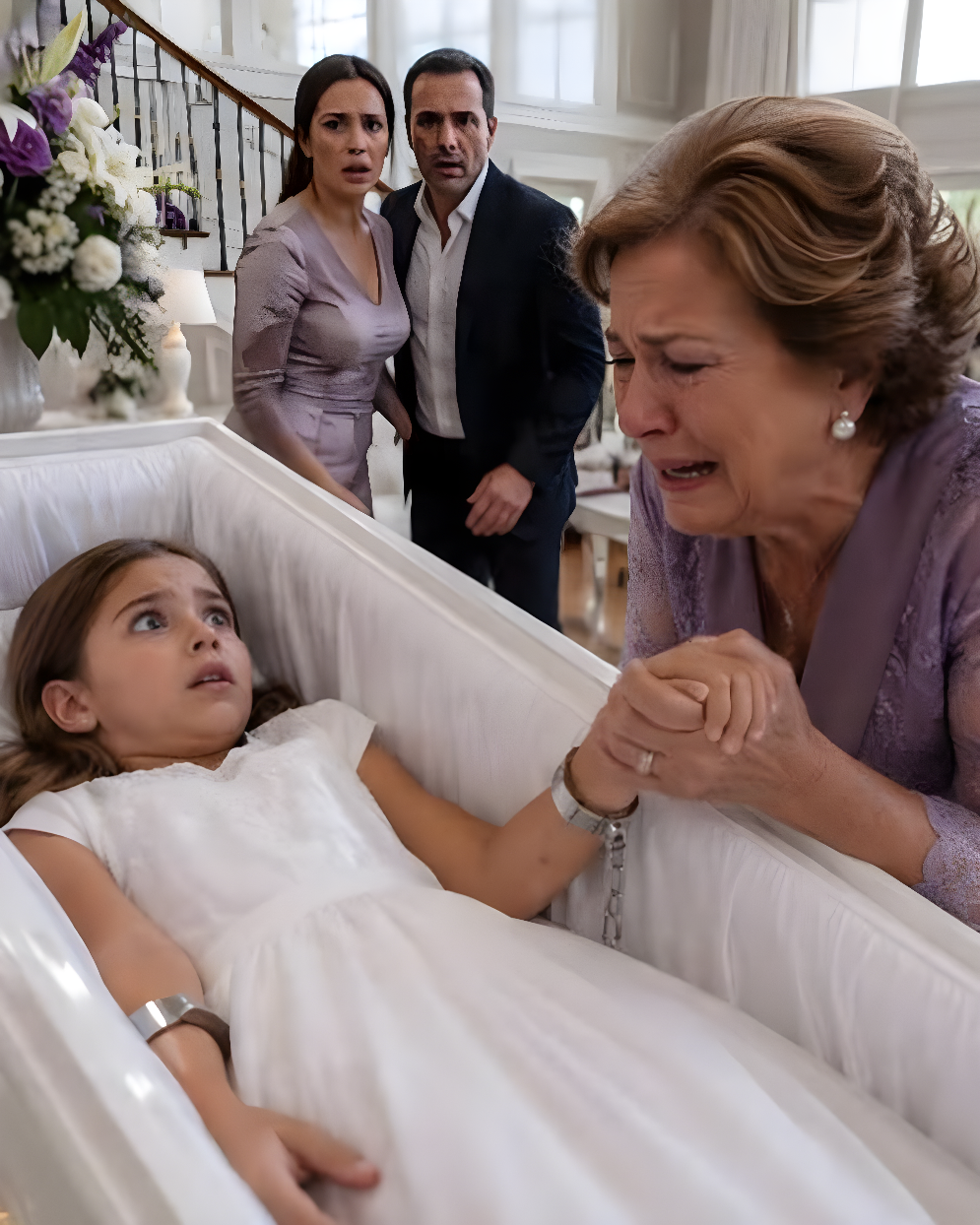
I was standing beside my granddaughter’s white coffin when I heard three faint scratches from inside it.
At first, I thought grief had finally broken something in my mind. The chapel was crowded, the air thick with lilies and candle smoke, and everyone around me was whispering about six-year-old Camila’s “sudden respiratory failure.” Her parents, Renata and my son Emiliano, stood near the altar in matching black clothes, accepting condolences as if they had rehearsed every movement.
Then I heard it again.
Scratch. Scratch. Scratch.
I grabbed the coffin lid. Emiliano caught my wrist.
“Mom, don’t,” he whispered.
His fingers were cold. There was a torn button on his sleeve, hanging by a single strand of blue thread.
“Why can I hear something?” I asked.
“You’re confused.”
Renata stepped closer, her face pale beneath her veil. “Camila is gone.”
I looked at the coffin. The white satin lining was too high around my granddaughter’s neck, and a strip of metal pressed against her wrist. I had asked to see her before the service, but they had refused. They said the doctor had warned against disturbing the body.
Camila had mild asthma. She had never been dying.
For seven months, Renata had canceled her doctor’s appointments. Every time I asked to visit, she said Camila was sleeping, contagious, exhausted, or too weak for company. When I protested, Emiliano told me I was making everything harder for the family.
Now my granddaughter was lying in a sealed coffin, and something inside had moved.
“Open it,” I said.
Emiliano’s jaw tightened. “The funeral director already closed it.”
“I said open it.”
He leaned toward me. His breath smelled of coffee and peppermint. “If you cause a scene, I will have security remove you.”
A low murmur spread through the chapel. Someone began crying near the back pew. Renata reached for my arm, but I pulled away.
Then I noticed a tiny key tucked beneath the coffin’s white lining. A dark blue medical bag sat near the doorway, where no one had placed it earlier.
I snatched the key.
Emiliano lunged. I screamed for help, and the chapel doors burst open. Two police officers rushed inside as the funeral director shouted that I was disturbing a body.
“Her hand moved,” I cried. “Please, open the coffin!”
The officers forced Emiliano back. Renata began sobbing, but she kept staring at the key in my palm.
The detective who arrived moments later examined the restraints, the coffin, and the strange blue thread on Emiliano’s torn sleeve. Then he turned toward the funeral director.
“Bring me every camera recording from tonight,” he ordered.
The man’s face went gray.
The detective opened his case, removed a sealed gray envelope, and reached inside as I held my breath…
PART 2
The detective pulled a small memory card from the gray envelope and handed it to an officer.
“Play it,” he said.
The chapel television flickered. At first, there was only a hallway and a timestamp. Then the image shifted to the funeral home’s preparation room.
Emiliano was standing beside Camila’s coffin.
He checked the door twice before kneeling near the head of the casket. Renata stood behind him, clutching a white cloth. I watched my son press his palm against the lid as though he were making certain something beneath it had stopped moving.
The recording had no sound, but I could read his lips.
“By morning, this won’t matter.”
Renata shook her head. He grabbed her arm.
The video ended before I could see what he had done.
“Where is my granddaughter?” I demanded.
The detective did not answer. He crouched beside the coffin and carefully removed the lining. The little key fit the restraint around Camila’s wrist.
When the lock opened, a tiny finger moved.
The chapel erupted.
Someone screamed. Renata collapsed against a pew. Emiliano shouted that I had ruined everything, then tried to push past the officers toward the coffin.
“Don’t let him touch her!” I cried.
The detective shoved him back. “Step away from the child!”
Camila’s lips barely moved. A weak breath escaped her.
“Grandma?”
“I’m here,” I said, gripping her hand. “I’m right here.”
The paramedics arrived within minutes. As they cut away the white funeral dress, they found bruises on both thighs, puncture marks at different stages of healing, and red bands around her wrists. One paramedic looked at the other, and neither spoke.
Renata began fighting the police when they tried to take her away.
“You don’t understand!” she screamed. “She was already dying!”
“She has a pulse,” the detective said.
A second officer pulled up a file on his tablet. It was a death certificate submitted by a private clinic, bearing the copied signature of Camila’s pediatrician. The cause of death was listed as respiratory failure. No autopsy had been required.
The pediatrician arrived at the hospital before midnight. Her face changed when she saw the photographs.
“Camila had mild asthma,” she said. “Nothing like this. I haven’t seen her in months because her parents kept canceling.”
Toxicology results came back just after two in the morning. Camila had a dangerous combination of sedatives in her blood, along with an untreated infection and severe dehydration.
The doctor spoke quietly. “If she had remained inside that coffin until morning, she might not have survived.”
I looked through the hospital window at my granddaughter beneath the machines. The funeral receipt was still in my purse.
Her cremation had been scheduled for ten thirty.
Then the detective placed another photograph on the desk. It showed a little girl with dark hair inside a different white coffin. Beneath it was an insurance settlement naming Renata as the beneficiary.
The detective stared at my daughter-in-law.
“Who is Lucía Herrera?” he asked.
Renata stopped struggling.
Emiliano lifted his head from the hallway floor and shouted, “Don’t answer that!”
And in that instant, I understood that Camila’s funeral had not been the beginning of the horror. It had been the continuation of something they had done before…
PART 3
The detective’s question opened a door none of us could close.
The photograph showed five-year-old Lucía Herrera inside a white coffin in 2017. The insurance policy named Renata as the beneficiary, and the death certificate carried the same false medical signature used for Camila.
Renata had once been Lucía’s mother.
Lucía’s father, Andrés, arrived in Guadalajara the next morning carrying a battered folder. Inside were years of custody petitions and letters returned unopened. He had been told his daughter died of an infection at a private clinic. By the time he reached the funeral home, she had already been cremated.
“I thought I failed her,” he told me in the hospital chapel.
“So did I,” I whispered.
But the truth was worse than either of us imagined. Detectives found a hidden blue medical bag in Emiliano’s office containing syringes, sedative vials, and six life-insurance policies on Camila worth fourteen million pesos. His laptop revealed gambling debts exceeding nine million. In a deleted message, a lender had given him ten days to pay.
Another recovered conversation was between Emiliano and Renata.
Renata had written that Camila woke too quickly the last time.
Emiliano replied, “Use what worked with Lucía.”
Renata warned him never to write the girl’s name.
He answered, “Not after tomorrow.”
A funeral-home apprentice named Diego later came forward. While arranging Camila’s coffin, he had felt warmth in her hand and seen her finger move. The owner told him to stay silent. Emiliano threatened his younger brother. Terrified, Diego loosened the restraints, hid the key beneath the lining, and recorded the preparation room on his phone.
That recording saved Camila.
It showed Emiliano checking the locks and saying, “By morning, none of this will matter.” It also revealed that the crematory had been instructed to begin immediately after the service.
Police arrested the funeral-home owner and Dr. Iván Rojas, the man from the old video with Lucía. Rojas eventually confessed. Renata had paid him to sedate Lucía and falsify her death certificate. She collected the insurance money, and Lucía never woke up. Years later, Emiliano discovered the records and copied the plan when his own debts became impossible to hide.
Renata claimed Emiliano threatened to expose her. That explained her fear, but it did not erase her choices. She bought the medication, injected Camila repeatedly, and helped prepare the false records.
Both were charged. Emiliano received forty-three years for attempted murder, abuse, confinement, fraud, and conspiracy. Renata received fifty-one years for what she did to Camila and for Lucía’s death. Rojas lost his medical license and received twenty-seven years. The funeral-home owner was sentenced to twelve.
Camila survived, but recovery was slow. She woke from nightmares, refused white clothes, and panicked whenever a door clicked shut. I never forced her. Her new room had yellow curtains, a moon-shaped lamp, and a door she decided would remain open.
A year later, she chose a white dress covered in yellow flowers.
At the register, the cashier called her a princess.
Camila shook her head. “No. I look like me.”
That evening, she asked whether I had saved her because I knew she was alive.
“No,” I told her. “I opened the coffin because I needed to say goodbye.”
She thought for a moment.
“Then I saved me,” she said. “Because I whispered.”
I pulled her close, but I did not hold her tightly. She had spent too long trapped inside other people’s hands.
The coffin key was kept as evidence until the final appeal. When the police offered it back, I told them to destroy it.
Camila would never need a key to escape again. She had found the one thing no one could lock away: her voice.